The race in Kentucky Saturday night was great. There was a close battle for the lead at the end and the race was run before a sellout crowd. Sort of. The only problem was that not all of that sellout crowd managed to make it to the track in time for the race.
Track owner Bruton Smith used the tag line "get lucky in Kentucky" in the months that led up to the tracks first cup date. "Lucky" is a word that I'm sure the fans that made it to the race would use. Those that didn't would probably use words like "inexcusable", "horrid", "atrocious" and some other words that are not fit to print. Some may have even uttered the words that no track promoter wants to hear: Never coming back.
Unless you were getting Twitter updates throughout the race or were physically at the track, you had no idea how bad the traffic situation was. The best way to describe it would be to call it an unmitigated disaster. The track just was not prepared for the amount of people that showed up, despite knowing for months that the first cup event at Kentucky Speedway would kinda be a big deal and more than a few people might show up for it.
Cars were backed up on I-71 for hours before the race was even close to starting. A line of cars that seemed to stretch on for miles was shown on Nascar Raceday, the pre-race show on Speed Channel. The show started a 4:30 pm and the race didn't start for three more hours. But cars were still backed up on 71 for at least twenty miles. Cars were still being parked as late as 100 laps into the race.
Track officials thought that the parking at the track, along with off-site parking areas, would provide enough room for all 107,000 fans to park. But clearly, they didn't anticipate the number of cars that showed up. The track didn't even have enough port-o-pots for fans that did make it in to use. One fan reported on Twitter that there was one port-o-pot every ten rows of cars. With about four people in a car, I'll wait till I get home thanks.
But undoubtedly the most sickening thing about last night's debacle is that track officials eventually ran out of room to park cars. That means that fans had to be turned away. Fans who had sat in traffic for as long a six hours, intent on seeing the first race at Kentucky, who spent their hard earned money on tickets and fuel to get to the track, were told they couldn't get in because there was no room to park. All that time, money and patience had gone for naught. Absolutely inexcusable.
The first thing the track needs to do, if anything can be done to make it up to these frustrated, heartbroken fans, is apologize. Track GM Mark Simendinger released a statement acknowledging the problem and promising better accommodations next season. Nowhere in the statement were the words "apologize" or "sorry" and until those words show up, fans are not going to forgive Kentucky Speedway.
The track will also need to offer some incentives for fans who either showed up late or never made it at all. Something along the lines of if you showed up late, you get 25% off your ticket for next years event. If you never made it at all, you get an immediate, full refund of your ticket price from this season and a free ticket to next season's event as a sign of benevolence. The fans are what drive this sport and somewhere around 5,000 of them never got to see what they paid for Saturday night. That's 5,000 who probably won't come back to Kentucky, or worse, may be turned off Nascar for good unless the track makes up for their mistake.
And let's be clear. This is not Nascar's fault by any stretch. Parking cars and making accommodations is the sole responsibility of the speedway. I guess they didn't think to add parking when they built those new grandstands to seat more fans. Maybe they were expecting some of them to walk? Daytona and Talladega continually see crowds in excess of what Kentucky officials saw Saturday and they never have a problem with parking. But Bruton Smith is a master of manipulation and this will all be a ploy to get the state to build new roads to ease any future congestion. Exaggerating that between 15, 000 and 20, 000 fans got shut out coupled with the fact Smith got on Nascar Raceday and proclaimed "I-71 sucks!" while it had two open inbound lanes that went completely unutilized, is just the leverage he needs to get state assistance.
But he can't wait for the state. He can't wait till next weekend either for that matter. People in the sport like Smith, Darrell Waltrip, even some Nascar execs have said that the speedway will do all it can to help make the situation for next year much better. But talk is cheap. Fixing the problems that left fans unable to witness the electric atmosphere of the first cup race in the "Bluegrass State" needs to happen now. If those diehard fans that got shut out don't see actual, physical efforts towards improvements made right away, this may be the first and last cup race at the Kentucky Speedway.
Saturday, July 9, 2011

Busch Wins Inaugural Kentucky Event
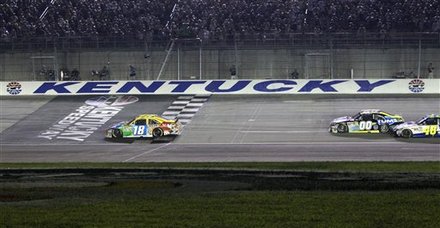 Nascar's Sprint Cup Series made their first trip to the commonwealth of Kentucky Saturday night. The atmosphere was electric as the forty-three drivers raced before a sellout crowd. The event was new to the fans and the facility was new to the drivers. The only thing that was familiar was the face in victory lane after the Quaker State 400.
Qualifying was rained out after twenty-two cars had timed in so, since the session couldn't be completed, the field was set by speeds from the first practice and the number of race attempts each driver has made over the first seventeen events. (This is why Michael Waltrip was sent home despite already qualifying fourth. He had only attempted two other races prior to Saturday night's event).
Because of this technicality, Kyle Busch started on the pole, which added insult to injury to the rest of the field because the No. 18 car had been on a rail since they unloaded and that speed stayed with the team through Saturday night. Kyle's brother Kurt showed early strength, but Kyle soon grabbed the lead back and never looked back.
The race was fairly uneventful early on. There was very little side by side racing and Busch, at one point had a lead of about five seconds. But once the sun went down, the action heated up. There were cars beginning to make their way to the front that looked to make a run at Busch's lead. Brad Keselowski and Tony Stewart grabbed the front row late by staying out when the rest of the leaders pitted and, surprisingly, they stayed close to the front on their old, worn out tires. Keselowski even managed to stretch his lead while Busch was mired in traffic.
There weren't a lot of caution flags either. The first big problem was when Jamie McMurray's engine grenaded in turn one. The back of the car caught fire and the cockpit filled with white smoke, but McMurray walked away unscathed and was cleared at the infield medical center. If you heard a loud, collective groan at some point last night as well, that was JR Nation reacting to their driver's late race problems. On their final stop, Dale Jr came down pit road, but slid his tires getting into his box. Since they just took gas, the No. 88 was sent back out on those same worn tires. As he merged onto the backstrech, his left front tire blew, ripping the fender and part of the hood to shreds. Junior's bad night had quickly come to an end.
On the final restart, Busch led Jimmie Johnson, while David Reutimann lined up third. Reutimann got a great start and was on Jimmie Johnson for second with as they came to the white flag. Reutimann's Tums Toyota did pass JJ for second as they came to the checkers (and would have passed Busch for the win had there been one more lap), but Kyle Busch grabbed the victory.
Busch also grabbed the points lead from Kevin Harvick after his win last night as well. He now leads by four points over Carl Edwards and ten over Harvick. Yes Busch won the race, but congrats should also go out to David Reutimann on his runner-up finish. Busch has come to expect victory, but Reutimann, who has only two cup wins the last two seasons, would have appreciated a Kentucky victory a whole lot more. He wanted it more than Busch did and you could tell in his post race interview with TNT, he was disappointed he didn't get it. And being as Reutimann's owner, Michael Waltrip, is from Kentucky, it truly would have been a special win for everyone involved. So congrats to Reut and his No. 00 Tums team on a hard fought second place finish.
Now it's time to put Kentucky in the rear view mirror and head up to Loudon, New Hampshire and the New Hampshire Motor Speedway. Will Jimmie Johnson repeat his victory from last year? Will Busch go back to back and win at the "Magic Mile"? Or will a driver like David Reutimann pull into victory lane and get their first win of the season at the New England racetrack?
Thursday, July 7, 2011
Michael Waltrip to Honor Brother in Kentucky


Since retiring from full time competition after the 2009 season, Kentucky native Michael Waltrip has made only a handful of starts in the cup series. All of these starts have been at either Daytona and Talladega, as restrictor plate racing is Waltrip's strongest suit, but when the opportunity to run in the first Sprint Cup Series race at his home racetrack, he couldn't turn it down. He's also running a special paint scheme just for the occasion.
Waltrip will run an orange and white No. 15 Camry to honor his brother Darrell's induction into the Nascar Hall of Fame. The paint job is similar to the one on the Terminal Transport car DW drove to his first victory at Nashville Speedway in 1975. The car will also feature the elder Waltrip's picture on the hood and a family photo from the victory lane celebration after that '75 win will be on the rear quarter panels.
"Seeing (the photograph) still makes me smile" Waltrip said. "This was when all the winning started and led Darrell to the Nascar Hall of Fame. What a happy group we were. So many people who helped him are in it, including my grandparents."
"I had never seen a man so happy" Mikey said of his brother in Nashville victory lane. "I have always idolized my brother, and because of him racing is all I ever wanted to do. It is truly special for our family that I will be able to honor him by driving this paint scheme at the first Sprint Cup race in our home state of Kentucky."
Waltrip will have to qualify on time because his car is outside the top 35 in owner points. But the other cars in Waltrip's position are not as funded or competitive, so making the field should be an easy task for the two-time Daytona 500 champion. Getting to victory lane will be a little bit harder, but if he can pull it off, it would no doubt be the biggest win of Mikey's career. It would be big not only because it would be a victory in his home state, but because he would be able to pay tribute to his racing hero, his brother Darrell.
Wednesday, July 6, 2011
Nascar Moves Nationwide Race From Indy Short Track to Brickyard

Much to the chagrin of track officials and short track fans across the nation, Nascar announced that they will move the Kroger 250 from Lucas Oil Raceway to the Indianapolis Motor Speedway in 2012, in hopes of re-energizing the cup weekend at the Brickyard.
Arguably the biggest race next to the Daytona 500, the Brickyard 400 trophy is one of the most coveted prizes in the sport. Every driver hopes that they will be the one that gets to kiss the bricks at the end of the day. But in recent seasons (especially after the 2008 debacle where teams could not run more that ten laps on a set of tires before one blew out) the race has lost some of the pageantry that came with racing at the most famous circuit in motorsports.
Meanwhile, up the street at Lucas Oil Raceway, the Camping World Truck Series and Nationwide Series held their events Friday and Saturday nights respectively before the Brickyard. Despite not racing with as much pomp and circumstance, the .686-mile track formerly known as Indianapolis Raceway Park produced some of the best racing seen all weekend. It allowed for good, old fashioned short track beating and banging, the kind of down to the wire, win at all costs racing that Nascar is all about. The track had also recently made several big investments, installing SAFER barriers and things to make the track more fan friendly for the future Nascar events they expected to hold. That is until Nascar pulled the rug out from under them and moved their big money event up the street to the big track.
So now that the Brickyard 400 weekend will be re-energized with the Nascar-owned Grand Am Series race, the new Nationwide event and the cup event Sunday, Lucas Oil Raceway's long history in Nascar is now over. Track GM Wes Collier said, while a stand-alone Nationwide race could work, a stand-alone truck race would not. The trucks just do not turn out the same crowd as the Nationwide and Sprint Cup Series' do and, because of that, the tailgate brigade will not be visiting the Indiana short track in 2012. It just disappointing that the track that has been around since the Nationwide (then Busch) Series began in 1982 (race sponsor Kroger has been around just as long) will have its one date taken away to help drum up a crowd for the series that should already be drawing one of the biggest audiences of the season. Is sacrificing the great racing at Lucas Oil Raceway to bring a few more fans to the Brickyard really worth it?
Sunday, July 3, 2011
Despite Late Race Action, Daytona Wasn't Racing
Daytona and Talladega have always been famous for big pack racing and drivers having to work through that pack using the draft and some skill to place their car into holes the might not normally fit in to try and win the race. That is until this season's Daytona 500. Since then, the fast way around the track is to get somebody behind you to push you around the track as fast as they can. No draft. No skill. No exciting passes. That all adds up to no racing.
Yes, the pack racing Daytona made famous is gone and has been replaced with a series of two car conga lines making their way around the 2.5 mile tri-oval. Just following each other until the one behind builds enough of a run to pass the one ahead of it. There is no more slingshot passing and two and three wide racing ten rows deep. Those aspects of the old Daytona that made it so exciting no longer remain. But we also know that the slingshots, three wide racing and last lap passes are what made the racing so thrilling and what made the fans stand on their feet and cheer. They never cheered for two cars pushing each other, building a head of steam and passing another two cars.
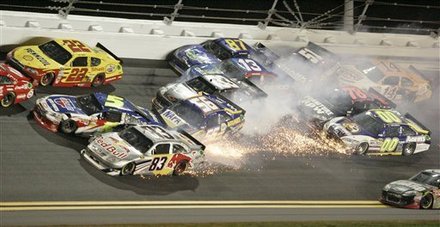
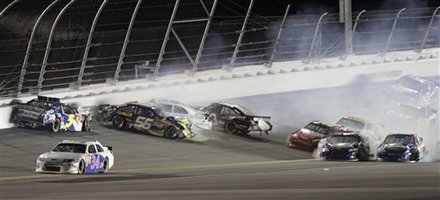
The Coke Zero 400 Saturday night should not have even been classified as a race. What the "race" should have been called was the Daytona Lotterty 400 presented by Coke Zero. It's all a gamble. These drivers take a chance that the car they're pushing won't get loose, spin out and ignite the pileup known as "the big one." We saw that happen last night when a wreck on a green-white-checkered took out fifteen cars and another wreck on the final lap involved another fifteen. Saturday night saw twenty five total drivers race 400 miles and all they had to show for their efforts were some bent sheetmetal. A garage full of wrecked race cars does not a great race make.
This isn't just an issue for the fans. Several of the drivers also can't stand it, the most vocal of whom is Dale Earnhardt, Jr who was wrecked as a result of the new racing on the last lap and who called the event a "foolish, frickin' race" afterwards. When asked why there was no last lap pass for the win, Junior said "what kind of move can you make? I mean, Jesus, man! What kind of frickin' move can you make when you're racing like this? There ain't no move you can make. You just hold it on the mat and try not to wreck each other - and you see how good we are at that." When the fans don't like the racing it's one thing, but when the drivers can't stand it, it's something else entirely.
The only solution to this problem is a change to the body styles of the cars. If Nascar raised the rear quarter panels so that a car could lift another driver's rear wheels off the ground if it pushed hard enough, that would definitely deter drivers from pushing the whole way around the track. Maybe when Nascar changes the cars in 2013 to give them more brand identity that will become a reality.
Nascar racing has always been about one thing: speed. It's every team's goal to have the fastest car come race day. It has never been about the guy who starts and parks every race getting lucky because the right guy pushed him to the lead. With the old pack racing, drivers had to earn a victory by racing three wide all day long, drafting in and out of traffic. They never won by waiting around and getting a teammate to push them with ten to go. In light of this new form of plate racing, fans need to ask themselves one question: Is this still racing? Or is it just a waiting game played at 190 mph?
Ragan Scores First Cup Win In Wild Coke Zero 400

UPS definitely has one of the most recognizable slogans in Nascar. "What can brown do for you" was the question decaled on the back of their race cars since their 2003 campaign with Dale Jarrett's No. 88 Ford. But, recent years, they have had very little success on the racetrack and the answer to that question seemed to be "not much."
After leaving Michael Waltrip Racing's No. 44 car to join David Ragan's No. 6 team in 2009, it looked as if the package delivery giant had made a huge mistake. That season, Ragan scored just one top ten in his new brown Ford, while David Reutimann (UPS driver at MWR for most of the 2008 season) scored ten top tens along with his first cup victory. The No. 6 team's luck continued in that same vein through the 2011 Daytona 500.
It seemed as if Ragan had the race locked up until he changed lanes before the start-finish line on the race's final restart. He was forced to do a pass through penalty, ending any chance at victory and allowing 18 year old rookie Trevor Bayne to score the win in the Wood Brother's historic No. 21 Ford.
This seemed to light a fire under this team. They scored four top tens in the first sixteen races this season and raced their way into the Sprint All Star Race by winning the transfer race held prior to the main event. The entire Roush-Fenway organization appeared to be on the upswing and this time the No. 6 car was no exception.
The cup series returned to Daytona Saturday night and it looked like the Fords were going to be tough to beat. Blue oval drivers Marcos Ambrose and AJ Allmedninger were first and second respectively in the lone practice session held Thursday afternoon. The next two Fords in line were Ragan and teammate Mat Kenseth. The Ford teams strength held up through qualifying as well, as Trevor Bayne scored second starting spot and Ragan netted fifth. All that was left to do now was to line them up and let them race.
Mark Markin led the field to green and it didn't take long for the race to get exciting. Trevor Bayne started second, but with the new two car tandem style of drafting it was near impossible for the Daytona 500 winner to stay up front with no teammate. He found Brad Keselowski in the middle of the pack and when the two hooked up in turns one and two on lap five, Keselowski turned Bayne into the outside wall. Bayne would not sweep the Daytona races and was relegated to a 41st place finish.
That was the only caution for the majority of the rest of the race. But the race didn't need the plethora of yellow flags we normally see in Daytona because the racing grew more intense and exciting with each passing lap. Kenseth and Ragan were big players, racing in the lead pack for most of the night, along with Red Bull teammates Kasey Kahne and Brian Vickers and Michael Waltrip Racing stablemates Martin Truex, Jr and David Reutimann. The Hendrick Motorsports foursome, also expected to be strong, played it conservative and hung at the back of the field all night.
But the complexion of the race really changed on the first green-white-checkered attempt. Because of the two car pack drafting, the drivers fight to hook back up with their partners right after the green flag waves before everything can thin back out a little, usually causing problems for everyone else. This proved true again when Mark Martin tried to move in front of Joey Logano before he had him cleared, spinning Martin's car and taking about nine others with him. Among the wreckage were Truex's No. 56, Reutimann's No. 00 and Vicker's No. 83. Logano raced on, but he had learned a hard lesson that most Florida drivers probably found out the same way. You never do know when that old man driving in front of you will change lanes without signaling.
David Ragan led the field on the following restart and quickly got hooked up with teammate Matt Kenseth. These two checked out, chased by Logano and Kasey Kahne. Logano's tandem did wrestle the lead away from Ragan's, but the two Roush-Fenway teammates quickly got it back and as fifteen other cars wrecked behind them, Kenseth pushed Ragan across the line first and the Unidilla, Gerogia native won his first cup race at Nascar's biggest track and erased any doubt that may have arisen in February about his ability to find victory lane. This was also UPS's first win since Dale Jarrett won the October Talladega race back in 2005.
Most people in the Nascar media said that David Ragan would be the next first time winner in the cup series. It wold just be a matter of time. He's silenced all his critics and proved that his No. 6 team is no longer the lame duck team at Roush-Fenway Racing. Now it's on to the Kentucky Speedway for a sold out Saturday night shootout among the Sprint Cup Series racers. Michael Waltrip will also make a rare appearance to not only race in the first cup race in his home state, but to honor his brother Darrell's recent induction into Nascar's Hall of Fame.
Both brother's are from Owensboro, Kentucky, so Kentucky Speedway was the track where Darrell made his first stock car start and where he scored his first win in 1975. Michael will run a paint scheme on his No. 15 Toyota paying homage to that winning Terminal Transport car and featuring DW's picture on the hood and the family picture from that '75 victory lane celebration on the quarter panels. Will a Waltrip return to Kentucky's victory lane? Or will we once again see what brown can do for Daivd Ragan in the Bluegrass State? We'll find out after 400 miles on Saturday night.
Saturday, July 2, 2011
Daytona Victory Would Be Much More Than a Win to Junior, Fans


February 18th, 2001. A day that will forever live in infamy in the Nascar record books. That was the day that Michael Waltrip won his first cup series race, however, that's not what it is remembered for. It was also the day that we lost Dale Earnhardt in the fourth turn on the final lap of that same Daytona 500. Waltrip and Dale Earnhardt, Jr (Earnhard's son), went on to finish one- two, but their celebration was short-lived as they found out what had happened behind them.
When the cup drivers returned to Daytona in July for the Pepsi 400 weekend, the focus (for good reason) was on Dale Junior and how he would handle racing on the track his father was killed racing on just five months prior. Would he wreck? Would he succumb to the pressure of racing in his father's shadow? Could he win?
July 7th, 2001. This is a day that most fans will remember as one of jubilant celebration and, in a way, healing. As the field came around for the white flag, Dale Junior and his teammate, Mikey Waltrip, raced nose to tail at the head of the pack. Although Mikey thought about pulling out and going for the win, he decided to block for his teammate. Nascar's favorite son had triumphed at the track where his father lost his life in one of the sport's darkest days.
But it was what happened after the checkered flag waved that really made this race memorable. Junior spun his car around in the infield grass, climbed out and stood on the roof, arms raised victoriously. Not too long after, Waltrip pulled his NAPA Chevy alongside his teammates car and stood on the roof to celebrate the win he never got to celebrate in February. The teammates embraced, their crews surrounded the cars in the grass, and the fans went crazy. They knew that it was going to be okay. Junior would continue the winning legacy of the Earnhardt name in Nascar's top division. The fans, teams and drivers could begin the healing process.
Now, Junior has since moved on from the team his father started, now driving the No. 88 for Nascar juggernaut Hendrick Motorsports. This Saturday's Coke Zero 400 marks the tenth anniversary of that momentous July victory. If Junior could snap his 100+ race winning streak a decade after that impressive win, it would mean a lot more to Junior Nation, and Dale Junior himself, than just another victory, I'm sure.
Subscribe to:
Posts (Atom)